 Excaloricate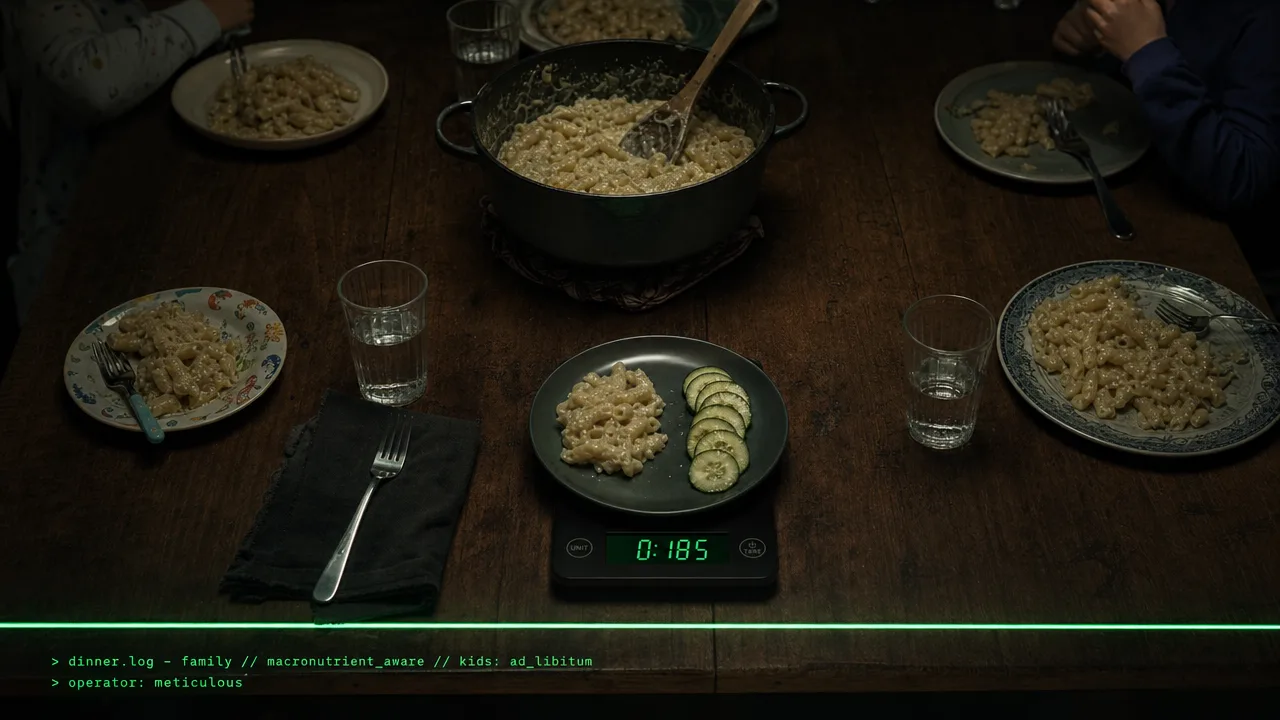
When Tomas pictured losing weight, he pictured a second kitchen.
He was 41, a software engineer in a small Czech town, and his kids — eight, ten, and twelve — ate the kind of food kids eat when their mother grew up in a family that fed people through hard winters. Pasta with cream sauce. Crispy schnitzel. Bread with butter at every meal. He had tried twice, in his thirties, to "do keto" while the family ate around him. Both times he lasted about three weeks. He'd be grilling chicken on a Tuesday while his daughter ate dumplings two feet away, and the math of it would stop making sense.
The thing he kept saying, when he told friends about it, was: "I can't cook two meals."
That sentence was the trap.
What actually changed
When Tomas started tracking again, almost a year ago, he didn't change anything about what the family ate. The kids still got their cream sauce. He still cooked it. The difference was that he started weighing his own portion before he sat down — not theirs, just his — and writing it down.
That was the entire first month.
He didn't cut carbs. He didn't swap his beer for soda water. He didn't say no to the bread basket when his mother-in-law visited. He just put his own plate on a kitchen scale, looked at the number, and logged it.
The first thing he noticed was that his portions, the ones he'd been calling "normal," were enormous. Not because he was greedy — because the family-sized pot in the middle of the table had no edges. There was no plate-shaped signal that said enough. He was eating until the visual cue (an empty bowl) arrived, and the visual cue arrived very late.
Once he was logging, the cue became a number. And the number was, on most days, about 1100 calories more than he needed.
The 200-gram rule
Around month two, he settled into something his wife now calls "the 200-gram rule." For dense, carb-heavy family dishes — pasta, rice bowls, mashed potato — he plated 200 grams of the main mass for himself, then loaded the other half of his plate with whatever salad or vegetable was already on the table, even if it was just sliced cucumber.
His kids ate whatever they wanted. His wife ate whatever she wanted. The cream sauce stayed. The dumplings stayed.
The only person on a diet was Tomas, and the diet was: smaller plate, more cucumber, write it down.
What the year looked like
It was not linear. He gained two kilos back in August, when his sister-in-law visited for three weeks and the household ran on barbecue. He lost them again in October. He stopped tracking entirely over Christmas because he didn't want a kitchen scale on a holiday table, and he didn't gain.
Twelve months in, he was 12 kg lighter. His blood pressure had dropped to a number his doctor actually grinned at. He was still cooking the same Tuesday-night cream sauce.
The story he tells now is shorter than the one he used to tell. He no longer says he can't cook two meals. He says he never had to.