 Excaloricate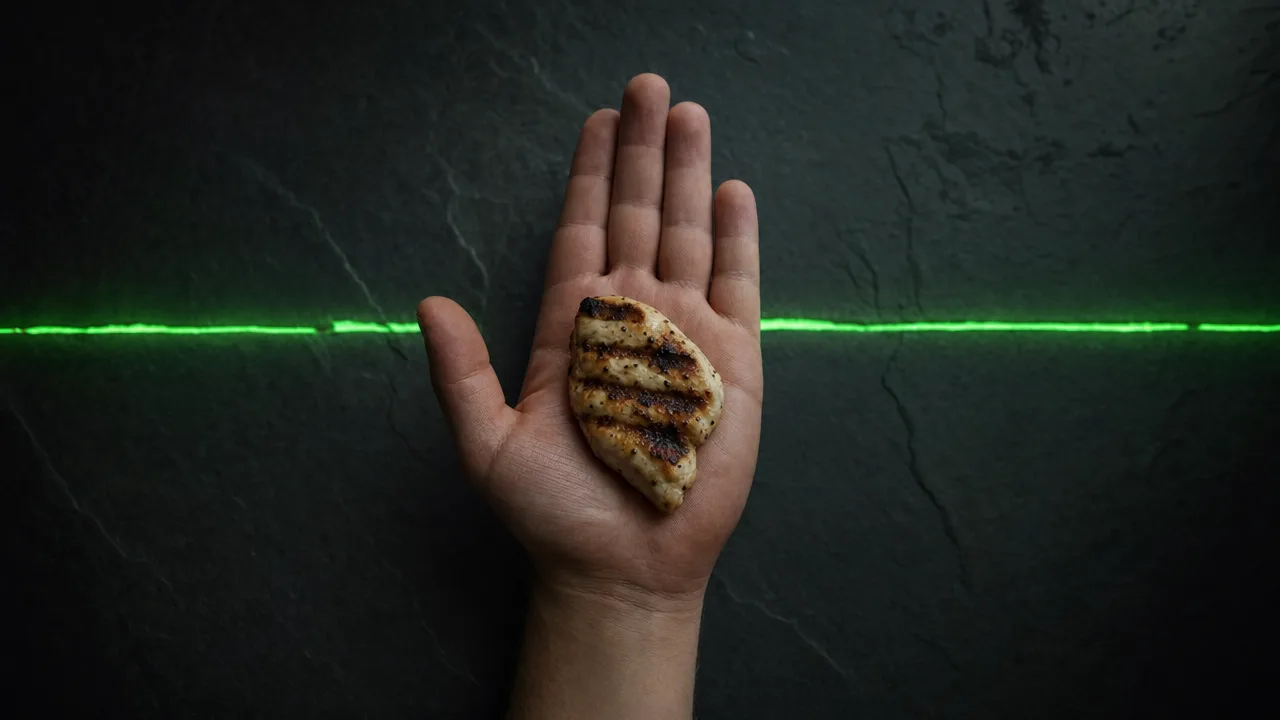
The kitchen scale is a great tool. It's also the single biggest reason people quit tracking after week two. You forget it at home. The battery dies. You're eating at your in-laws and pulling out a digital scale next to the roast would be, let's say, socially expensive.
So learn the cheat code: your hand. It's always with you, it's roughly proportional to your body size (which already roughly tracks how much you need to eat), and it's accurate enough to keep your daily total honest.
The hand-based portion system
These are the anchors. Memorize four.
- Palm = ~100 g of cooked protein. Your flat palm, no fingers, roughly the thickness of a deck of cards. One palm of chicken breast, salmon, steak, tofu, or tempeh is one protein portion.
- Cupped hand = ~30 g of dry carbs or ~150 g cooked. One cupped handful of dry oats, rice, or pasta. After cooking they roughly triple in weight, so a cupped hand of cooked rice is about a side portion.
- Thumb = ~1 tablespoon, ~10–15 g of fat. One thumb of olive oil, peanut butter, butter, or cheese. Fats are the easiest macro to drastically underestimate; this is the one to internalize first.
- Fist = ~1 cup of vegetables. One fist of broccoli, salad, roasted peppers. Vegetables are basically free calorically — don't bother weighing them, just notice you ate some.
That's it. Four shapes, four numbers.
Why this works (and where it breaks)
Hand size scales with body size, which scales — imperfectly but usefully — with energy needs. A 100 kg construction worker has bigger hands than a 55 kg accountant, and also needs more food. The system self-adjusts.
Where it breaks down:
- Mixed dishes. A bowl of pasta carbonara isn't separable by hand-portion. Estimate the parts: a cupped hand of pasta, a thumb of cheese, a palm of bacon. Add them up.
- Liquid fats hidden in cooking. A salad with two tablespoons of olive oil dressing isn't a "fist of vegetables" — it's a fist of veg plus two thumbs of fat (around 240 kcal you didn't see).
- Dense vs. fluffy foods. A cupped hand of granola is twice the calories of a cupped hand of cornflakes. When in doubt, weigh the dense stuff once, remember what it looked like, and reuse the visual.
A faster way: just describe it
The truth is, even hand-portioning is slower than what most people actually want, which is to type "two slices of margherita pizza and a beer" and move on with their day.
That's the bet behind logging by description: the AI applies the same hand-based intuition (plus a much larger reference library) and gives you a number that's good enough. You override it if it's obviously wrong. Over a week, the errors cancel out, and your trend line is what matters anyway.
What to actually do this week
Pick one meal a day — usually dinner — and estimate it by hand before you eat it. Just guess. Don't look anything up. Write down the kcal you'd bet on.
After three or four days you'll start to notice the same foods recur, and your guesses get faster. The scale becomes optional. The tracking habit becomes portable. That's the goal.
The best portion system is the one you'll still be using in six months. For most people, that's the one already attached to their wrist.