 Excaloricate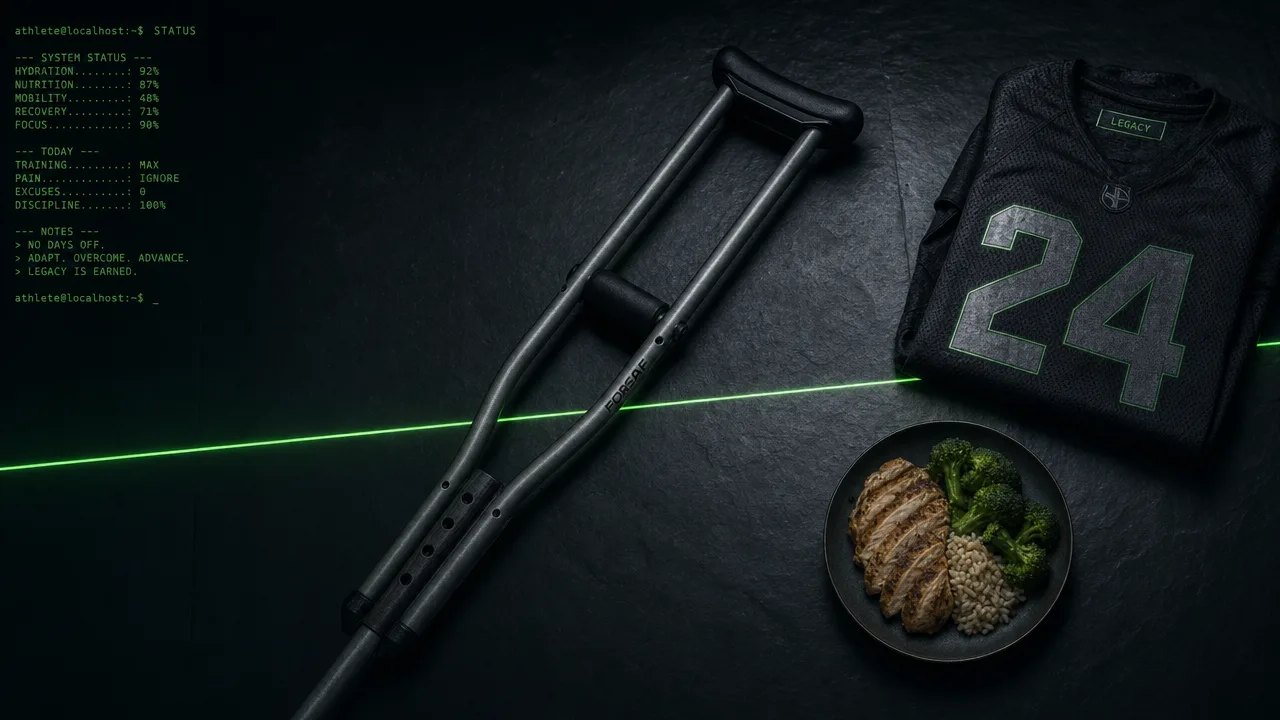
Mateo had always eaten like an athlete because he was one. Five-a-side twice a week, a Sunday league match, the occasional run. Food was fuel, and he never thought twice about a second helping or a post-match beer — he'd burn it off by Tuesday.
Then, in a meaningless Sunday game, he came down wrong on his right knee. Torn ACL. Surgery, then weeks on crutches, then the slow grind of rehab. The pitch — the thing that had quietly balanced his appetite for fifteen years — was suddenly gone.
The weight he didn't see coming
The first month he barely noticed. By the second, his jeans told the story before the scale did. He was eating exactly the way he always had — the portions of a man who ran twelve kilometres a week — except now he was on the sofa with his leg propped up. Nobody had warned him that the calories don't pause when the activity does.
When he finally stepped on the scale, he was up 6 kg. Frustrated and a little embarrassed, he did something he'd never had to do before: he started paying attention to what he actually ate.
"I'd spent my whole life assuming exercise would clean up after me. Take that away and I had no idea how much I was really eating."
Working with what he could control
Mateo couldn't run. He couldn't squat. For a while he could barely manage the stairs. So he stopped fighting the part of the equation he couldn't change and focused on the part he could: what went in.
He started logging every meal — not to obsess, just to see. The picture was unflattering and clarifying at the same time. The "small" handful of nuts in front of the TV was 300 calories. The recovery smoothies he'd kept drinking out of habit were basically liquid dessert. The portions that made sense for a footballer were far too big for a man on crutches.
A few changes did most of the work:
- He right-sized his plates to match his new activity level, not his old one.
- He cut the liquid calories first — the smoothies, the juice, the after-dinner beer — because they were the easiest to lose without feeling deprived.
- He kept protein high so the muscle he was slowly rebuilding in rehab had something to work with.
Rehab and the scale moving together
As the months passed, two things happened at once. His knee got stronger, and the scale started moving down — slowly, a little under half a kilo a week. By the time his physio cleared him for light jogging, he was already 7 kg down. He kept logging through the return to sport, and by the end of the season he'd lost 10 kg and was leaner than he'd been before the injury.
The lesson stuck with him. Exercise had never really been his weight-loss tool — it had just been hiding how much he ate. The injury forced him to learn what every athlete eventually finds out: you can't out-run your fork, and you don't need to.
These days Mateo is back on the pitch. He still logs. He just no longer assumes the next match will erase whatever the week throws at him.